









/sites/default/files/banners/2017-08/436x980_en.jpg
Fast rail link set to boost local Thai economy while helping to bring Belt and Road Initiative closer to reality.

Closer Thai ties: High speed rail-link set to connect Bangkok to major mainland cities.
The anchor project of Thailand's Belt and Road-related infrastructure plans has long been the construction of a new rail line connecting Bangkok to China via Laos. To date, though, negotiations between China and Thailand with regard to the project have been protracted, with the two parties disagreeing over a number of the key issues. In September last year, however, it was agreed that work on the first phase of the project would begin later this year.
The project, expected to cost 500 billion baht (US$14.2 billion), is a key element of China's Belt and Road Initiative (BRI). Its proposed first phase will focus on the construction of a 256km high-speed railway link from Bangkok to the city of Nakhon Ratchasima, with this initial project expected to take three years to complete.
The second phase – projected to take up to two years – will focus on the construction of a 355km rail link from Nakhon Ratchasima to Nong Khai, a northeast Thai city bordering Laos. Once completed, the line will connect directly to the China-Laos railway, putting Vientiane, the Lao capital, within four hours journey time of Bangkok. From Vientiane, travellers can then proceed to Kunming, the capital of China's Yunnan province.
A proposed third phase would see the construction of a 246.5 kilometre line linking two provinces Saraburi in central Thailand and Rayong on the country's east coast. There is also a longer-term plan to extend the line south, offering connections to Kuala Lumpur and Singapore.
The Thailand-China railway is seen as a good fit with Thailand's own infrastructure development strategy – a comprehensive five-part, 1.9 trillion baht plan scheduled to be completed by 2022. Overall, these initiatives are all tied into the country's goal of establishing itself as the key strategic and logistics gateway to the ASEAN Economic Community (AEC).
In terms of Thailand's own development, the potential gains from the Thailand-China railway are seen as hugely significant. Assessing its likely impact, an academic study by John Draper and Peerasit Kamnuansilpa, two lecturers at northeast Thailand's Khon Kaen University, indicated that it was set to improve Thailand's connectivity with Myanmar, Laos and Vietnam via similar local BRI-related projects. The connection with Myanmar was also seen as ultimately leading to the creation of a new economic corridor linking China, Bangladesh and India.
Additionally, according to the academics, once the Thailand-China railway links-up to the Trans-Asia railway, Bangkok will be directly connected to Chengdu, the capital of Sichuan province, home to a thriving electronics, IT, and car-manufacturing sector. It will also bring Bangkok to within 15 days of rail-freight time to Lodz, Poland's third-largest city.
Among the other expected benefits of the link will be a sharp increase in the number of mainland tourists travelling to Thailand. China is already Thailand's leading tourism source market and its fastest-growing. In 2015 alone, Thailand attracted eight million Chinese tourists, a 71% increase on 2014. These 2015 visitors accounted for 376 billion baht in revenue, an 87% rise on 2014. Mainland tourists now account for more than 25% of all overseas visitors to the country.
From China's perspective, its investment in Thailand is seen as making good economic sense. Not only is Thailand advantageously located geographically, but it also has highly developed logistical, trade and finance resources. By nurturing Thailand as the primary logistics hub within the ASEAN bloc, China ultimately stands to gain greater access to Southeast Asia's 600-million strong market.
Despite these clear benefits, negotiations with regard to the rail project have been far from smooth. Among the many concerns raised were the interest rate China proposed with regard to its financial support, the overall ownership structure and the construction costs. Thailand is also believed to have baulked over China's pursuit of development rights along the railway's rights of way.
These concerns led Thailand to reject China's initial funding proposal, opting instead to finance the project through domestic loans, bond issues and the establishment of an infrastructure fund. All of the trains and signaling systems, however, will still be purchased from China.
Ultimately, for the project to prove a success, Thailand will need its investment to be repaid by a substantial increase in trade. At present, its trade with China is still rising, with the country both its largest export market and its second-largest source of imports. China has also been Thailand's second-largest foreign investor, after Japan, for the past seven years.
While some see risks in Thailand's growing dependence on China, there is also a sense that it is currently by far the best option on offer. Overall, the rail project is seen as certain to strengthen Thailand's role as the key conduit for trade and expertise between the ASEAN bloc and China. With global trade entering a period of uncertainty, such a role could be crucial to ensuring Thailand's own economic well-being.
Geoff de Freitas, Special Correspondent, Bangkok
Content provided by 
Editor's picks
Trending articles
HKTDC Research | 24 Jan 2017
Indonesian Infrastructure Early Beneficiary of Belt and Road Backing
The setting for the launch of the Belt and Road Initiative, Indonesia has been one of the first to benefit from the massive investment China has subsequently unleashed in order to deliver its ambitious global logistics and infrastructure upgrade.
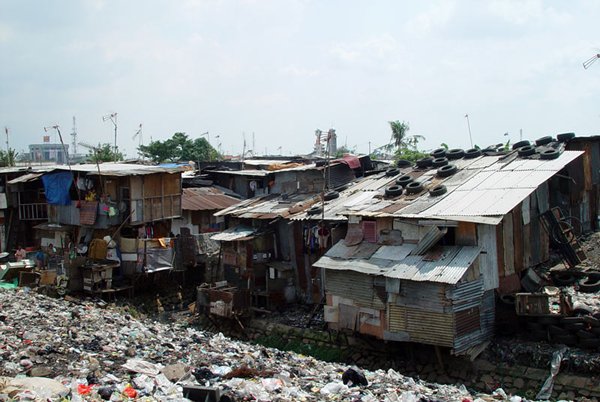
Jakarta slums: Set to be cleared in a massive China-backed development programme.
It wasn't by chance that Xi Jinping, the Chinese President, chose Indonesia as the setting for the 2013 launch of the Belt and Road Initiative (BRI). As the largest economy in the ASEAN bloc and with the highest population, Indonesia is rich in the natural resources that China lacks. Despite this, its growth has long been hamstrung by poor infrastructure and limited investment. By contrast, China is short on natural resources, flush with money to invest and eager for new markets to replace the still flagging demand in the US and Europe. For many, then, there is a natural fit between the two economies.
Subsequently, Indonesia has proved to be a key link in the proposed Maritime Silk Road, the element of the BRI that focuses on the development of sea ports, aviation resources, energy and communications. An archipelago nation, Indonesia has been noticeably short of investment in all of these sectors.
According to figures from the country's Ministry of National Development Planning (Bappenas), Indonesia needs IDR7,200 trillion (US$600 billion) to support its planned infrastructure upgrades over the 2015-2020 period. With the central government only able to supply about 25% of the required funding, overseas investment is seen as essential. It is hardly surprising, then, that Indonesia has been a prime supporter of the China-driven Asian Investment Infrastructure Bank (AIIB). At present, it is the AIIB's eighth-largest shareholder, with a capital subscription of $3.36 billion.
Although Indonesia had already found some success in boosting its inward investment, since the launch of the BRI programme its progress has accelerated substantially. According to the Indonesian Investment Coordination Board, the country attracted inward investment of $628 million in 2015. For 2016, the total for the first quarter alone stood at $500 million.
There has also been a fundamental change in the source of its investment. Most notably, US FDI in Indonesia has declined dramatically, falling from 8.3% in 2013 to 2% in 2015. This shortfall, however, has been more than made up for by investment from Singapore, Japan, China and Hong Kong.
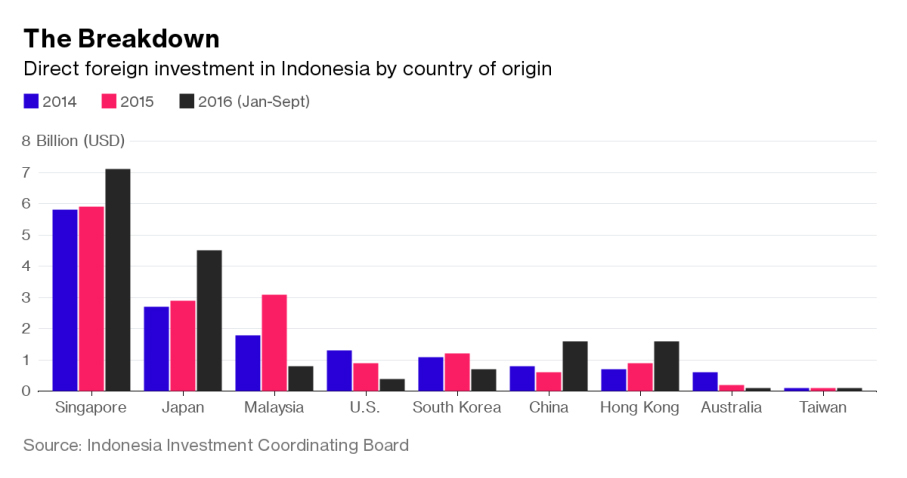
China, of course, has significantly ramped up its investment. In 2015, a financing framework of $3 billion was agreed upon in a Memorandum of Understanding (MoU) between the Chinese and Indonesian governments. This saw the China Development Bank agree to fund 52 projects in co-operation with a number of local Indonesian financial institutions.
Speaking after the announcement of the MoU, Azhar Lubis, the Deputy Chairman of the Indonesian Investment Coordination Board's Department of Investment Supervision, said: "Over the coming years, the level of potential investment from China will remain high. Our biggest challenge is ensuring that potential can be realised quickly."
To date, one of the major projects to have received Chinese funding is the Tanjung Sauh Port on Batam Island, an Indonesian Free Trade Zone just to the south of Singapore. Backed by investment from the China CAMC Engineering Company, it is hoped that the first phase of the redevelopment of this container-focussed facility will raise its capacity to four million TEUs.
The AIIB has also approved $216.5 million of funding for Indonesia's National Slum Upgrading Project. The initiative has been co-financed with the World Bank and is intended to improve access to urban infrastructure and services for the 9.7 million of the poorest residents of 154 towns and cities across Indonesia.
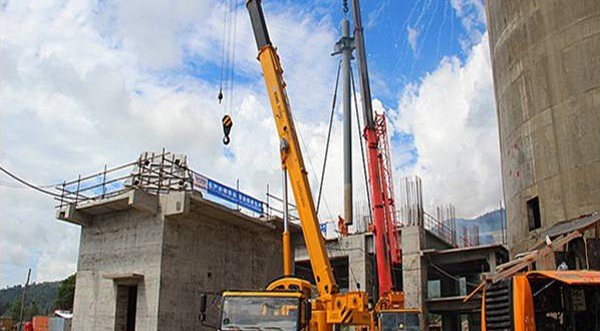
Concrete investment: The Papua Cement Plant.
In terms of rail infrastructure, the Jakarta-Bandung High Speed Link is now being developed by PT Kereta Cepat Indonesia China. The company is a joint venture between a consortium of Indonesian state-owned businesses and China Railway International, with the project being backed by the China Development Bank.
On the utility front, PLN – a state-owned Indonesian electricity provider – has signed up to deliver 17,331 megawatts, with Chinese companies set to utilise 46% of this capacity. China has also funded the construction of the Medan-Kuala Namu-Tebing Tinggi Toll Road in Sumatra, the Cisumdawu Toll Road in Java, the Manado-Bitung Toll Road in North Sulawesi and the Samarinda-Balikpapan Toll Road in Kalimantan. Mainland money also contributed to the costs of constructing the Manokwari Cement Production Plant in Papua.
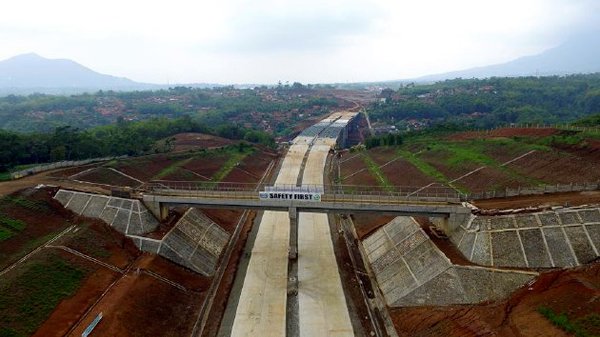
Backed by mainland money: The Cisumdawu Toll Road in Java.
Hong Kong, too, has been keen to accelerate its own investment programme, signing an MoU with representatives of Indonesia in May 2016. Highlighting the role Hong Kong is playing in the development of the BRI, Charles Ng, InvestHK's Acting Director General of Investment, said: "The MoU signed with Indonesia is the ninth that we have signed with a country along the BRI route. As a 'super-connector' between mainland China and the ASEAN bloc, Hong Kong provides an excellent platform for any Indonesian company looking to access the vast mainland market, as well as for any mainland business looking to explore the ASEAN market."
Geoff de Freitas, Special Correspondent, Jakarta
Content provided by
Editor's picks
Trending articles
With an open and transparent market and a level playing field, Hong Kong attracts an international group of world-class professionals who are looking to take the lead in Asia. Such expertise will be critical for businesses aiming to find opportunities under mainland China’s new development strategy known as the Belt and Road Initiative.
Editor's picks
Trending articles
10 Jan 2017
“One Belt, One Road” - Mapping China’s main outbound route
By Pinsent Masons
Pinsent Masons has supported The Economist Corporate Network to create,'One Belt, One Road: an economic roadmap', a series of guides to areas including Africa, Asia, the Middle East and Eastern Europe.
The publication provides informed consideration about the opportunities and implications of OBOR. Along with mapping investment routes and opportunities, the reports feature insight on:
- Infrastructure projects and plans
- The likely impact of local political conditions on investment
- Key economic indicators
- A transparency and stability index.
The regional sections list infrastructure project pipelines with analysis of the infrastructure need in the constituent countries. The analysis examines the progress of prominent OBOR projects and conclude with a series country profiles that offer brief but detailed political-economic portraits.
The country profiles include an “infrastructure risk radar” that succinctly relates the state of core elements in a nation’s infrastructure base: port facilities, air transport facilities, retail and distribution network, telephone network, road network, power network, rail network and IT infrastructure.
The profiles list population and key economic indicators and contain a table on operating risk measures. The operating risk measures look at risk levels for security, political stability, government effectiveness, legal and regulatory conditions, the macroeconomy, foreign trade and payment, finance, tax policy, the labour market and infrastructure.
The Economist Intelligence Unit Democracy Index 2015 and its previous annual editions provide further context for describing a country’s system of government, governance quality and environment for transparency.
Please click to view the profiles of over 44 countries, ranging from Albania to Zimbabwe.
Editor's picks
Trending articles
HKTDC Research | 12 Jan 2017
Guangdong Enterprises Tapping Belt and Road Opportunities: Kennede Electronics Steps Up Exports
Kennede Electronics Co Ltd is one of the many businesses looking to capitalise on China’s Belt and Road Initiative as a way of tapping the rapidly growing Asian markets. The company has hopes of exploring investment opportunities in a number of areas, including Africa, in a bid to reduce its production costs, while strengthening its market coverage in Asia and Europe. Additionally, in order to advance its production and global sales, Kennede Electronics is in the process to set up a company based in Hong Kong to take advantage of the city’s professional services and trade facilities.
Belt and Road Markets Look Promising
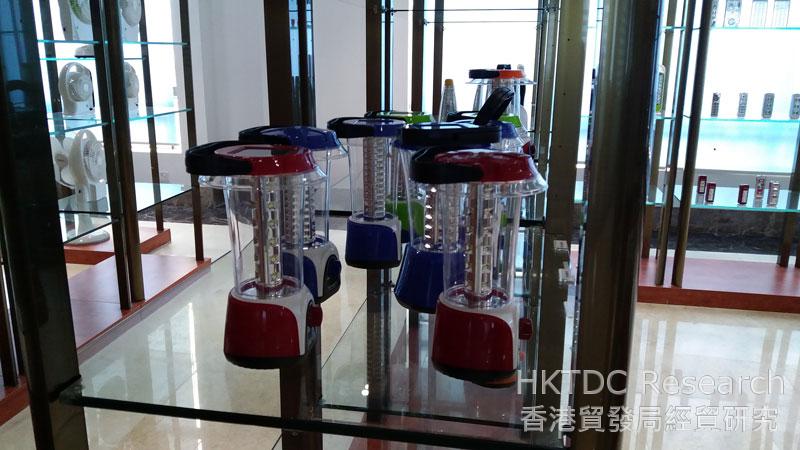
Headquartered in Guangdong’s Jiangmen city, Kennede Electronics is a specialist maker of backup lighting and electrical products. At present, the company is optimistic about the market potential of the Asian countries along the Belt and Road. It has plans to further develop its dealings with the major South Asian markets, notably India and Pakistan, as well as the Southeast Asian markets in Malaysia and Thailand.
A representative of the company told HKTDC Research that demand within the global lighting market is mostly stable at present. However, growth in the developed markets, such as Europe and the United States is relatively slow. Somewhat against the odds, then, over recent years the company has achieved impressive sales figures by developing new products, building new sales channels and opening new markets.
Since its inception in 2000, Kennede Electronics has focussed on production and overseas trade for its main exports. These exports cover major lighting series - rechargeable indoor and outdoor backup lighting; rechargeable flashlights; and fire emergency lights. They also include rechargeable desktop and floor fans. Kennede currently owns more than 600 series of products, marketing them to more than 100 countries and regions. In January 2014, the company was listed on the Small and Medium-sized Enterprise Board in the Shenzhen Stock Exchange.
Exploring Overseas Investment Opportunities
Kennede Electronics has comprehensive plans in place to expand its production capacity to match future business developments. These plans cover the increased application of standard modules, as well as altering product design to better suit its Jiangmen plant’s automated production capacity.


The company also intends to explore investment in manufacturing plants within the central region of China. It is also studying the feasibility of setting up production lines in Africa. It plans to combine foreign labour and production resources in order to better control its overall production costs, and break into the African markets via local strongholds. In all, using Africa as an overseas production base could enable the company to service the European market more effectively.
When evaluating potential investment in production projects, the company believes that a number of major factors - other than labour supply and production costs - must be considered. The environmental protection requirements of investment locations, as well as other matters such as supply chain and production materials support, also need to be taken into account. Consequently, the company is looking to build its local knowledge prior to any potential investment in Africa.
Although Southeast Asia is geographically closer to China, the company reckons that the continuous inflow of foreign capital has prompted a surge in local production costs. As the labour supply is no longer abundant, some Southeast Asian countries have begun to tighten their requirements for foreign investment in production projects. As a result of this, the company is currently focused on African investment projects, and has reduced its focus on investment opportunities within Southeast Asia.
At present Kennede Electronics is in the process of setting up a company in Hong Kong. As an international financial centre, Hong Kong offers facilities for dealing with foreign exchange, collecting international payments and securing cost-effective capital to finance growing international business. The company also hopes to take advantage of Hong Kong's professional consulting services, amongst others, to undertake feasibility studies in overseas investment projects and early due diligence. This would enable it to control its investment risks and carry out appropriate tax planning to avoid the unnecessary burden of double taxation.
HKTDC Research would like to acknowledge the help extended by the Department of Commerce of Guangdong Province and the Bureau of Commerce of Jiangmen City in conducting surveys and company visits.
| Content provided by |  |